
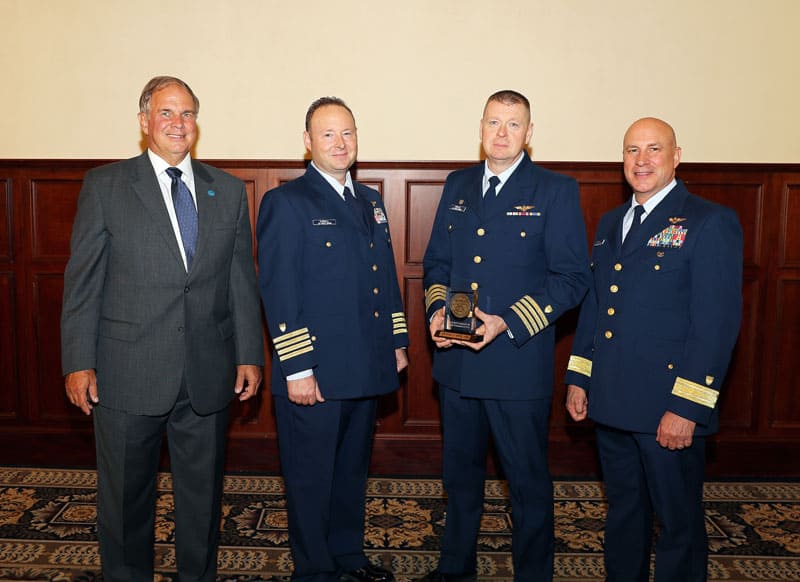
The Commander Elmer F. Stone Award is presented to Air Station Cape Cod crew of CGNR 2317, CDR Hester, LCDR O’Brien, AMT2 Guillermo, and AMT3 Carter, in recognition of their heroic efforts on 1 December 2016, in responding to a critically ill newborn on Martha’s Vineyard. The crew of 2317 was dispatched from Air Station Cape Cod as a severe winter storm passed through the region, grounding civilian life flight services. In visibility barely above the minimum required for takeoff, 2317 departed for Boston’s Logan Airport to retrieve a specialized neonatal team comprised of five medical professionals and an Isolette unit (incubator for newborns) needed to safeguard the infant during flight in the HC-144. After navigating through heavy rain which severely limited visibility and caused dramatic wind shear, CDR Hester initiated and successfully completed a challenging instrument approach, continuing below the minimum descent altitude with only the approach lighting system visible, before finally acquiring the runway at just 180 feet.
During the demanding approach, LCDR O’Brien acted as the Safety Pilot delivering calm and precise support enabling well coordinated Crew Resource Management to minimize the significant risks associated with operating in the region’s busiest airspace. After landing, AMT2 Guillermo and AMT3 Carter conducted a comprehensive safety brief, rapidly loaded the five member team and Isolette and completed an essential performance check to ensure all of the required medical equipment was functioning properly. With the weather deteriorating, 2317 departed for Martha’s Vineyard. While en route, LCDR O’Brien continuously updated the aircraft’s flight management system to reflect changing winds and weather conditions, calculated aircraft performance for the next phase of the mission, and coordinated with Air Traffic Control to request priority handling. Arriving in the terminal area of Martha’s Vineyard, the crew discovered that ceilings on the island had dropped to 200 feet, which compelled them to once again initiate another difficult instrument approach. Commander Hester flew the precision approach to a safe landing despite the treacherous wind shear that subjected the aircraft to dangerous and unpredictable buffeting just prior to touching down, at times requiring nearly full deflection of the flight controls to remain on profile.
Once on deck at the airport, Petty Officers Guillermo and Carter immediately took charge of the medical team and shepherded them safely off the aircraft and facilitated their movement around the hazardous spinning propellers. After working to stabilize the infant for two hours on deck, the neonatal team informed the air crew that the Isolette’s oxygen supply would be entirely depleted in 35 minutes, placing the newborn in grave danger. Racing against the clock, Petty Officers Guillermo and Carter quickly secured the Isolette and the medical team in the cabin for the turbulent flight back to Boston. 2317 proceeded directly to Logan Airport where LCDR O’Brien took the flight controls for the completion of the crew’s third instrument approach to landing, breaking out at the decision altitude. Expert coordination with Boston’s ground controllers allowed 2317 to rapidly taxi through the heavily trafficked airport, delivering the infant to advanced medical care with only minutes of oxygen remaining.